If you run a small or mid-sized business in India, your office network likely stores customer information, financial records, employee credentials, and business communications, all of which are valuable targets for cybercriminals., financial records, employee login details, and daily business transactions. However, the business owner sees the firewall as an IT problem, rather than a business one.
The truth is, choosing the right Business Firewall isn’t just about buying the most expensive device available. Instead, focus on choosing a Firewall for Small Business based on factors such as your business size, budget, future growth plans, and security requirements., future expansion plans, and the types of cyber threats you are realistically likely to encounter.
This guide explains everything in simple, easy-to-understand language. No complicated technical jargon, just practical information to help you choose the right network protection for your business.
What is a Firewall and Why is it Crucial for Small Businesses?
Think of a firewall as a security guard standing at the entrance to your business network. It tracks all data and connections in and out through the internet. If it identifies suspicious or harmful traffic, this security appliance blocks that traffic before it reaches your systems.
A lot of business owners think that installing anti-virus software is enough to keep them secure. That’s not true. Antivirus protects only individual computers or devices, whereas a network firewall secures your entire network, including office computers, Wi-Fi networks, remote employees, and any device connected to the internet.
Cybercriminals are increasingly targeting small businesses because they often have fewer security resources than large enterprises., believing that they are more vulnerable than large enterprises. Without proper Firewall Security, there is a risk of loss of information from the clients, ransomware attacks and business disruptions – the biggest loss is client confidence.
If you have ever wondered, “What exactly is a firewall for a business?” Or if you are asking, “Does my office need a firewall?”, the simple answer is, if your office has two or more computers or devices connected to the internet, then installing a firewall is essential.
Types of Firewalls Explained (Which One Do You Actually Need?)
That’s where most business owners go wrong. Firewalls come in different types, and understanding the differences can help you select the right security solution for your business. You can learn more about different types of firewalls before making a decision.
A hardware firewall is a physical appliance placed between the office’s broadband Internet connection and its local network. A hardware firewall may be advisable if your office is based in a specific location and has on-premises servers.
A software firewall is installed on computers, laptops, or servers. While it is simple to install and affordable and will protect the device it is installed on, it is not designed to secure your entire office network.
A UTM (Unified Threat Management) firewall is an all-in-one security solution. Combines the functions of a firewall, antivirus, intrusion prevention, content filtering and many more security functions in a single device. For a small business, a UTM firewall is a viable solution as you don’t need to maintain numerous security devices.
Next-Generation Firewall (NGFW) observes the network traffic more closely and can monitor and control applications. With the rise of remote work and cloud applications, More businesses are adopting Next-Generation Firewalls (NGFWs) as remote work and cloud applications become more common. But not all businesses need this high level of security. If you are a small-scale business, it’s essential to assess if the added features of an NGFW are really needed.
The final choice of the best firewall is dependent on various elements, including the number of team members, office areas, and remote staff members.
Hardware vs Cloud Firewall: Which Is Better for Small Businesses?
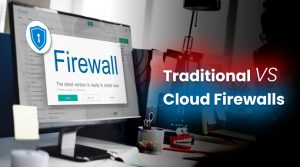
There’s no universal “better”, only what fits your setup, Hardware Firewall and a Cloud Firewall, only what fits your setup. Here’s a quick side-by-side to help you decide:
| Factor | Hardware Firewall | Cloud Firewall |
| Best suited for | Single office location with on-site server | Remote/hybrid teams, multiple branch offices |
| Setup | Physical device installed on-premise | Managed off-site, no hardware needed |
| Scalability | Requires new hardware as you grow | Scales easily as team grows |
| Performance | Not dependent on internet speed | Depends on internet connection quality |
| Updates & maintenance | Manual updates, needs on-site attention | Automatic updates, managed remotely |
| Cost structure | Higher upfront cost, more predictable long-term | Lower upfront cost, ongoing subscription |
| Control | Full control over configuration on-site | Managed by provider, less physical control |
| Ideal for | Teams handling sensitive data locally | Growing or distributed teams |
If your team primarily works from one office, a hardware firewall may be sufficient. Businesses with distributed teams can also explore top cloud-based firewall solutions to improve scalability and simplify remote network security management.
Key Features to Look for When Buying a Firewall
After you’ve decided whether you need a hardware, software, or cloud firewall, it’s time to compare products. Businesses looking for advanced security features can explore best enterprise firewall solutions based on their network size and security requirements. Now, rather than concentrate on marketing statements, think more in terms of features that will impact your business security. Quick installation and usability.
If you don’t have a full-time IT team, select a firewall that will not require a security expert.
VPN Support
When employees travel often and/or your team is remote, VPN access is no longer a luxury; it’s a necessity.
IDS/IPS (Intrusion Detection and Prevention System).
This capability can be used to prevent continued cyber-attacks by identifying suspicious activity. Real-time protection is critical, as well as blocking known threats.
Scalability
Your firewall needs to expand as your business grows. The hardware capacity and licensing of the firewall should be flexible if you’re having a lot of employees come and go or are anticipating growth in the future.
Reporting and Network Visibility:
A quality firewall offers visibility into the network firewall, as well as blocking threats, strange logins, traffic to and from the internet, and security events. This will enable you to keep an eye on your network more effectively.
Ongoing Support
This is something that many businesses forget about. A firewall is not a one-time purchase and install product, so routine updates, security patches and monitoring are very important. Therefore, when purchasing a firewall, be sure to inquire about AMC (Annual Maintenance Contract) and support services from your Firewall Vendor.
How much does a firewall cost?
Firewall Price in India can greatly depend on the particular brand, model, performance and duration of the license. For example, a Firewall from a vendor such as Fortinet, Sophos or SonicWall varies in price based on throughput, number of users and licensing agreements (1 year, 3 years or 5 years).
A better way is to ask for a quote that’s based on your use and business needs rather than take the time to rely on price lists. This guarantees you get the appropriate solution and the correct pricing. If you want to purchase a firewall online or are looking for a small business-friendly firewall, you need to get your hands on the services of a reputable Firewall Vendor offering proper Firewall Installation. This means that you not only get the firewall device itself, but the correct configuration, installation and technical support as well.
Buying a firewall that is more powerful than the business needs. Not all businesses need an enterprise-class firewall. A firewall used for 500 users is no use at all if you have 15. If the office only has 15 employees, buying a firewall that’s designed for 500 employees is just an unnecessary waste of time and money. Use a firewall according to your needs.
Common Mistakes Small Businesses Make When Choosing a Firewall
Focusing only on hardware price while ignoring subscription costs
Some companies only think about the one-time purchase of the firewall product, and don’t consider annual subscription or renewal fees. Through this subscription, however, they receive regular security updates, and the latest threat protection is provided. Thus, it is also essential to understand the total cost of ownership besides the cost of hardware.
Failing to have a maintenance plan
Failing to review and update a firewall over the years is a frequent error. Cyber threats are constantly evolving, so it is essential to regularly update and maintain the firewall. This is the reason an AMC (Annual Maintenance Contract) is crucial, as it guarantees that your security is kept updated.
Skipping professional installation
Even if a firewall is set up correctly, it can still have vulnerabilities in the network. Thus, it is better to have an experienced firewall vendor or security expert who is familiar with the configuration than to try to do it yourself.
Choosing a firewall without making any comparisons.
All businesses are different. Therefore, whenever you’re considering buying a firewall, you should always try to compare a few so that you can see how each will meet your team size, budget, future growth plans, and security requirements. A little more research can pay off in the long run in better value and better security.
Conclusion
When it comes to picking the right firewall, it isn’t about the best firewall in the market; it’s about identifying the firewall that is best suited to your business today, and will be best suited to your needs tomorrow as well. Consider the size of the team, remote needs, budget, and risk exposure – and let those considerations help you make the choice, not the marketing promises.
Whether you’re wondering about hardware vs cloud, the cost of a firewall, what is firewall price in India, or how to pick the correct firewall product for a business, BUY Firewall UTM is a firewall reseller and a partner who can help you choose the right firewall solution, install it and ensure it’s maintained correctly without any guesswork. Whether it’s deciding on UTM firewall solutions, or seeking firewall support services, it’s better to talk to someone who deals with this all the time than to try to figure it out on your own.